1. icon for News
  2. icon for TCHOW

News

Showing posts with label graphics. Show all posts

Tuesday, May 17, 2016

Convex Horizons

Today, I started thinking about the complexity of a certain geometric problem: finding the horizon of a set of convex objects. In this post, I'll first state the problem and then attempt to explain why this is an interesting problem to think about.

The Convex Horizon Problem

Given a list of 2D convex objects, return a function h that maps each x-coordinate to the maximum y-coordinate such that (x, h(x)) is contained in some object. This is the "horizon" or "skyline" of the objects.

First Reduction: when working with convex polygons, this is equivalent to finding the horizon of a series of line segments; or, equivalently, trapezoids with bottom edges at negative infinity. So this is the version of the problem I'll be thinking of:

(The horizon of the many-hued trapezoids is the thick black polyline.)

Thoughts on Complexity

Any algorithm that computes such a horizon must spend time at least linear in the number of output points in the horizon line. So it's interesting to think about how many points this could be. Particularly, I find this intriguing because of two different (related) problems.

The Box Horizon problem pretty clearly has output of size at most 4N (for N boxes). The argument goes something like: the horizon is a chain of line segments alternating between flat segments and vertical segments. The vertical segments correspond to the vertical edges of boxes, and each box edge appears at most once in the list. This means there are at most 2N vertical segments, which must (therefore) separate at most 2N horizontal segments.

(Mind you, the time complexity of an algorithm that computes a box horizon from an unsorted set of boxes is likely O(N log N), given as reducing sorting to box horizon seems likely to be trivial.)

The logic used to argue for the output complexity of box horizon breaks for trapezoid horizon because the topmost trapezoid can switch not just at an edge, but at a line segment intersection. And it's easy to see that there can be quadratically many intersections among lines:

But this standard lines example doesn't have a clear translation to the trapezoid horizon setting! So that leaves an interesting puzzle: is there some other argument that can be used to demonstrate linear output complexity of trapezoid horizon? Or, failing that, what's a super-linear output complexity example for this setting?

I plan to ponder this more over the next few days. If you have some ideas, feel free to get in touch.

Wednesday, November 13, 2013

Math: What is the right Aspect Ratio?

In the shower the other day, I thought up an interesting question: what is the right aspect ratio to work in? (With, of course, the immediate follow-up question: what does "right" mean in this context?) In this post, I'll attempt to answer both questions with some simple math.

Setup

I've been doing some pre-production work on a storybook game for iOS devices. The game will likely be composed of full-screen scenes with hand-drawn background plates. I don't want to have require new background plates for every resolution (much less aspect ratio), so the plan is to create one background and fit it to the screen.

So, depending on the screen aspect ratio (in this case: 4:3 on the left, 16:9 on the right), some of the image will be cropped, either off the sides or off the top and bottom.

Minimizing Waste

Since I'm not of a mind to have something drawn that isn't needed, one possible definition of "right" aspect ratio is the one that minimizes wasted area in the background image. So how much area is wasted?

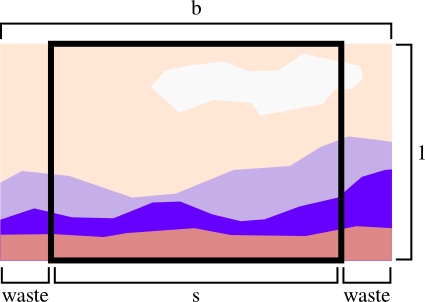
Well, denoting the aspect ratio of the screen s and the aspect ratio of the background image b, and -- without loss of generality -- assuming the screen height is 1, it is easy to draw a picture of the situation:

So, if the background is wider than the screen, the percentage of the background image wasted is (b-s) / b. Similarly, when the background is narrower, the waste is (1/b-s) / (1/b).

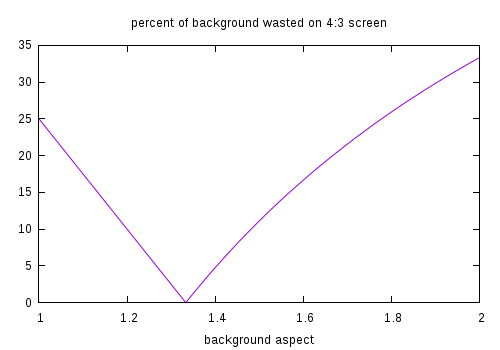
As expected, on a 4:3 screen a background image of aspect ratio 4:3 wastes the least.

Of course, on iOS one needs to worry about three aspect ratios: 4:3 [iPad], 3:2 [iPhone <= 4], and 71:40 [iPhone >= 5]. (In case you are wondering, 71:40 is 'nearly 16:9'.):

NOTE: I'm only considering landscape aspect ratios because that's the target for this game.

Assuming one wants to give equal weight to background waste on each device, the proper aspect ratio of the background image should minimize the sum of these three curves.

This minimization happens at the 3:2 aspect ratio. Indeed, my intuition is that with equally-weighted devices the minimum-waste aspect ratio will always be the median aspect ratio.

Maximizing Excitement

In the previous section, I counted areas of the background for each time they were cropped -- that is, background that didn't show at 4:3 and at 3:2 was counted as being twice as bad as background that was only cropped at 3:2. Perhaps, instead of obsessing over these lost pixels, one should instead maximize the percentage of the background that is cropped by no device (i.e. the part of the background every screen sees).

What is this percentage? Consider a background of size bx1 to be shown on screens of aspect s1, ..., sN. The width of the visible-on-all-screens region is w = min(b, s1, ..., sN), because the background will be cropped after its aspect exceeds the smallest screen aspect. The height of the visible region is h = min(1, b / s1, ..., b / sN), because of cropping on the top and bottom of edge of the background when it is scaled to the widest aspect ratio. (More intuition: consider scaling the visible region to [horizontally] fit a screen of size sx1. The scale factor is s / b, so it must be the case that h * s / b <= 1; thus h <= b / s.)

Putting these figures together gives percentage 100 * min(b, s1, ..., sN) * min(1, b / s1, ..., b / sN) / (b * 1). Interestingly, this means that maximizing visible area only depends on the narrowest and widest aspect ratio under consideration:

The unfortunate news is that with aspect ratios of 4:3 and 71:40 in the mix there isn't any background size that doesn't end up with about 25% of its area not visible on all screens. The fortunate news is that the best aspect ratio in terms of waste (3:2) is within this 75%-used plateau.

Going Further

In this article I didn't talk at all about foreground content (which must be scaled to fit within each aspect ratio), and only explored two objective functions. Other interesting objective functions might include one weighted for all browser sizes, or one that is concerned with fairness (forcing all screens to lose about the same area of the background).

If you have other ideas, feel free to leave a comment or send an e-mail.