1. icon for News
  2. icon for TCHOW

News

Tuesday, August 11, 2020

Interactive vs Generational Collaboration

My research group has been writing a lot of papers recently. Like any reasonable set of CS folks, we use LaTeX as our typesetting tool of choice. Of course, like any modern set of collaborators, we also all want to be editing the paper at the same time, changing words as others are writing, and completing each-others sentences.

To accomplish this, we have generally turned to Overleaf, which -- like LaTeX itself -- isn't a great solution to the problem, but it is the best solution we have. One of the interesting things about Overleaf is that it supports two completely different models of collaboration, which -- for the purposes of this post and without reference to any external sources -- I'll term "interactive" and "generational".

Interactive Collaboration

Interactive collaboration models a shared workspace. All changes are made simultaneously and with fine-grained (real-time) synchronization. Interactive collaboration seems to work best when edit operations are "local" -- generally modeled by granting participants a notion of a cursor or selection around which their edits are centered.

Interactive collaboration doesn't work very well with dependent or global edits (e.g., trying to make an overarching change to the order of sections). And -- as often happens on Overleaf -- it really doesn't work well when the synchronization system begins to bog down.

Generational Collaboration

Generational collaboration models... well, I'm not exactly sure what it models. Perhaps a series of independent artifacts, individually crafted, but with reference to other previously created artifacts? Regardless, changes are made individually, and merged non-real-time into a final artifact.

Generational collaboration works well for changes that don't overlap and (thus) can be merged automatically. It is, thus, a natural fit for global but distinct changes (e.g., changing all references to a figure; doing a global re-ordering of paragraphs in a the "Results" section while another collaborator works on the "Introduction" section).

Further, generational collaboration can operate in a decentralized and disconnected way, which are distinct advantages, especially on a paper deadline when nobody has time to wait on a slow server. (Or, e.g., on an airplane.)

Combining the Models

So, how do we combine the models to get the benefits of both?

Overleaf's approach is to support the generational collaboration model via git push/pull support, but to require that no interactive edits happen between a git pull and the subsequent git push. This, effectively, makes generational collaboration lower priority than interactive, making it incredibly awkward to leverage this model while others are using the interactive model.

My preference here would, instead, be to start with a decentralized generational model and build in some notion of interactivity. I tend to like disconnected/disjoint tools, so perhaps the way to do this is to have the notion of a multiplayer editor protocol that can work (optionally, in parallel) with a git repository.

Here's a sketch of how that might work:

When a multiplayer (text?) editor opens a file, it would check in the same folder (and parent folders) for a .multiplayer subdirectory and contained config file. (Similar to how git looks for a .git subdirectory.)

The .multiplayer config file would contain either the address of a responsible server and a project token to identify the project to that server, or a list of peers to contact directly. Any multiplayer-capable editor would -- after prompting the user -- get the list of peers to coordinate editing with (possibly via connecting to a server, possibly via direct peer entries). The server could also handle STUN to make peer-peer communications easier.

Regardless, said multiplayer-capable editor would now be connected to a peer cloud and could use peer-to-peer multicast techniques to keep the document synchronized, publish cursor state, and so on.

So that takes care of the interactive collaboration. How about the generational part? We could make it so the .multiplayer directory contains a reference to the most recent point in shared edit history at which an editor had synchronized to the peer cloud. If -- when your multiplayer editor connects -- your current file matches the recent version in the .multiplayer directory, then all changes between that version and the current peer cloud version could be automatically applied.

If, on the other hand, your current file differs from the reference version in the .multiplayer directory, then there's a generational change to merge. This is the classic "three-way merge" problem that (e.g.) git solves reasonably well. In the interactive setting, it might even make sense to allow you to request others stop for a second and help with the merge.

Of course, if your text editor of choice doesn't support multiplayer, you could still edit single-player and use a command-line utility to deal with the three-way merges. (Perhaps with a "hang on, let's do the merge together everyone" option to avoid the same problem that overleaf has.)

So, Who's Building It?

Perhaps the most surprising thing for me in my (scant) research around this topic is that nobody has built an interoperable interactive collaboration system that actually supports, e.g., cross-editor cursor sharing; at least not one that is still in action today (I seem to recall that google docs at some point had an API with cursors).

Perhaps the notion of a cursor is so editor-specific that it takes special sauce to do it. Perhaps the idea that you need to run a server makes people want to lock in users to finance said server. And perhaps I just haven't looked hard enough.

In the latter case, let me know! I'd love to try out something different with my group when we next have a big crop of papers ready to go.

Tuesday, July 28, 2020

Puzzle Nutrients and The Cubedex of Brass and Wood

The Cubedex Series of games were each designed as virtual puzzle hunt replacements. As such, they have a particular flavor that grew out of my puzzle hunt design strategies. In this post, I will describe what I look for in a cubedex game puzzle, and talk about how these relate to The Cubedex of Brass and Wood, which is forthcoming on Steam (indeed, there is a demo there now).

The Puzzle Nutrients

I tend to think of puzzle-hunt style puzzles as having a few different archetypes. In reality, perhaps they are more like ingredients -- in that they can be mixed and complementary -- or like nutrients, in that a healthy puzzle hunt should contain a balance of all of them.

They are, in no particular order:

Hidden Puzzles

Hidden puzzles present the player with an unknown artifact and ask them to understand the artifact in order to solve it. These are the bread-and-butter of puzzle hunts, and require a sort of logical twist wherein the player must hypothesize rules under which the puzzle might contain information and extract that information. Once the proper rules are found, the puzzle becomes simple to decode, and provides some sort of structure that convinces the player that their decoding is correct.

The simplest hidden puzzles are those that present information in a known encoding scheme -- like resistor color code, semaphore, or ASCII, to name a few -- lightly obscured by some sort of transformation (e.g., written in letters which are mirrored). More interesting encoding puzzles may present physical artifacts that need to be manipulated to produce the decoding effect (e.g., a literal decoder ring, a pattern that must be viewed through a color filter, or -- in one of my favorite examples -- a set of paper tiles, only some of which were treated with a fire-retardant chemical).

A prototypical encoding puzzle in The Cubedex of Brass and Wood is The Clock, which combines a decoder-ring-like device with another encoding scheme.

Combinatorial Puzzles

Combinatorial puzzles challenge the player to find a satisfactory solution from a large solution space. The solution space is generally abstract and generally contains very few satisfactory solutions. This makes brute force search infeasible (or, at least, tedious). However, in contrast to hidden puzzles, the quality of a solution isn't ever in doubt.

Typical puzzles of this sort include physical put-together puzzles (e.g., build a cube from these tetrominoes, fill a bird silhouette with these tangrams) and constraint-satisfaction puzzles like Sudoku. In The Cubedex of Brass and Wood, the prototypical combinatorial puzzle is probably The Balance, in which the player must fill a tray with masses so that it balances.

This puzzle type generally requires one to either constrain the search space by developing a higher-level understanding of the puzzle, or to write a computer program that searches and checks solutions for you. I think both of these solution methods can be really satisfying; indeed, sometimes they can be combined to produce a really, really satisfying solution -- like realizing that "Lights Out" can be solved by using linear algebra over finite fields, or that state equivalence via move reversibility allows for the creation of more efficient Sokoban solvers.

Performance Puzzles

Performance puzzles ask the player to interact with an artifact in order to manipulate it into a good state. Performance puzzles mix well with hidden puzzles and combinatorial puzzles, adding a layer of reflex- or precision-based challenge to the existing puzzle.

I think that performance puzzles are often neglected in a puzzle hunt context because they can be hard to run for a large group in person (for all that they can also be spectacularly fun). Virtual performance puzzles really open up more options in this regard.

The Cubedex of Brass and Wood's performance puzzle is The Maze, which requires reasonably fine control of the angles of mirrors to direct a beam of light to enable walls to be moved. The version of this puzzle you get in the retail game is actually a toned-down version relative to the original; in the version you'll be able to play, you get to trigger wall movement manually. In the original, wall movement was automatically triggered and any stray hand motion could cascade and ruin the entire maze setup. My testers found this incredibly frustrating, so I changed it.

The Machine is another Cubedex of Brass and Wood puzzle with performance elements, though it is in some ways also a hidden puzzle, given that the interaction rules are not clear. (Arguably, for some variants, it is also a combinatorial puzzle, as at least one tester [threatened to] use Z3 to extract a logical formula consistent with the device's behavior during their solution attempt.)

Building Puzzles

A building puzzle asks the player to assemble a device to overcome a challenge. Like a combinatorial puzzle, the building blocks and goal are generally reasonably straightforward. However, the solution often relies on a [simulated] physical task, rather than a discrete measure of correctness; and the solution space is generally large and open-ended.

Good examples of physical puzzle hunt building puzzles include building a bridge over an obstacle, designing a Lego gear box with a specific ratio, or building an autonomous vehicle that can cross a specific terrain. I use that last idea in The Cubedex of Brass and Wood in The Cart, where the player builds a line following robot using real[-ish] vacuum tube logic components.

One of the fun things about building puzzles is that the players can often design "cheesy" solutions that just barely work; The Cart is not immune to these sorts of solutions, but I think I've included at least one variant of the puzzle that will be hard to solve in an unintended way (prove me wrong! -- it's always fun seeing how these things can be broken).

A Balanced Puzzle Diet

These are the four basic puzzle nutrients that I think about when building a puzzle hunt or game. They can serve as a prompt to make sure the hunt is balanced, or as a lens to look through when attempting to solve a puzzle.

As I continue to polish and release the Cubedex Series, I hope you will look out for these puzzle types in the games. Every game aspires to be a complete meal, but they certainly have different balances of nutrients within them (e.g., The Cubedex of Boxes and Lines is almost entirely hidden puzzles with a performance element).

Sunday, April 9, 2017

Who Wins (Simple) Gwent?

So, a few weeks back, I played some of the beta of Gwent, an online two-player deck-building card game. This post analyzes a very simple version of the game -- one where the cards have value but no text, and both players always draw the exact same cards -- and shows that in this simple version, perfect play results in a tie.

Basic Rules

Let's start with the rules.

Gwent is a two-player card-based point-accumulating game played over three rounds. Players begin the game by drawing 10 cards, of which they may redraw three. During each round, players take turns playing cards. Each card changes the players' points totals. If a player doesn't want to play any more cards during the round they can "pass". The round is over when both players pass.

The player with the higher point total at the end of the round is the winner. In the case of ties, both players are considered to have won. If either player has reached two wins, that player wins the game. If both players win simultaneously, the game is considered a draw. If neither player has reached two wins yet, another round is played.

Points totals are reset at the end of each round. Players replenish their hands by drawing two cards after the first round and one card after the second round.

The first player for the first round is determined randomly; for subsequent rounds, it is the player that won the previous round. I forget what happens in the case of ties, but it's not crucial for the analysis below. (I think that the lead switches.)

Before the game begins, each player constructs a deck of 25 (or more) cards. These decks are where each player draws their cards from. The contents of this deck is limited in various ways that I won't discuss, since part of the conceit of this post is that we're going to ignore the existence of decks and assume each player draws the same cards.

This treatment of the rules also neglects discussions of Factions, Leaders, and Card Text. Briefly, each player must choose a Faction when building their deck. This Faction limits which cards may be used in the deck, and may provide a global ability [e.g. "redraw an extra card at the start of each round"]. Each player must also choose a Leader. A Leader is essentially an extra card that is always drawn at the start of the game. Finally, each card may have complicated Card Text which specifies how it interacts with the point totals and other game state. For the discussion that follows, none of these things will be considered.

Simple Gwent: Provably Boring

In "Simple Gwent", which I will talk about for the rest of the post, all cards have a positive point value, each player starts with the same hand, and both players will draw the same cards between rounds.

It turns out that Simple Gwent always ends in a draw if played competently. Specifically, I will demonstrate that each player can force a draw, regardless of what the other player does. I break this strategy into four cases, depending on the state of the game. In each case, the players are labelled F and S, "first to act" and "second to act". Note that labels may change between rounds.

Case Zero-S: Score 0-0, Same Cards; S to draw/win

In the first round, the second player can guarantee a draw by playing a simple strategy:

  • Play whatever F just played.

This always results in a draw with identical cards remaining, at which point player S uses strategy One-F or One-S to force a draw/win (I don't recall if lead switches on a draw).

Case Zero-F: Score 0-0, Same Cards; F to draw/win

In the first round, the first player can guarantee a draw by playing a very basic strategy:

  • Pass.

This results in one of two outcomes:

  1. Player S plays at least one card and wins; in which case Player F uses strategy Behind-S next round.
  2. Player S passes, which results in a draw, in which case Player F uses strategy One-F or One-S (depending on if the lead switches in a draw) next round.

Case Behind-S: 1-0 (F winning), S Has Card Advantage; S to draw/win

In the second round, when S has a strict superset of F's cards (that is, S has all the cards F has, and at least one additional card), S can force a win/draw by playing as follows:

  • If F plays, play the same card.
  • Once F passes, play the cards in your hand that F does not have in their hand, then pass.

This guarantees a win for S, bringing the score to a 1-1 tie, and making both player's hands the same. At this point, S uses strategy One-F to guarantee a win/tie.

Case One-F: Score 1-1, Same Cards; F to draw/win

In a round where both players have already won and have the same cards, the first player can guarantee at least a draw by following this strategy:

  • Play all cards.

This results in one of two outcomes, depending on what player S does:

  1. If player S plays all their cards, resulting in a tied match and game.
  2. If player S does not play all their cards, and player F wins the match and game.

Case One-S: Score 1-1, Same Cards; S to draw/win

In a round where both players have already won and have the same cards, the second player can guarantee at least a draw by using this strategy:

  • Play all cards.

This results in one of two outcomes, depending on what player F does:

  1. If player F plays all their cards, resulting in a tied match and game.
  2. If player F does not play all their cards, and player F wins the match and game.

Conclusions and Notes

The above demonstrates that Simple Gwent is boring whenever both players draw the same hand and know it. In other words, [full] Gwent is very much a deck-building game -- your basic goal as a player is to make sure that you end up with a better draw than your opponent. Of course, this also suggests that it would be interesting to figure out just what a good draw looks like (obviously, it should be high-scoring; but perhaps it is more important that it have two [three?] high-scoring subsets).

Also, the "Pass First" strategy seems really weird in this context -- shouldn't F take the opportunity to get an early win? Not always! Consider a simplified scenario where players start with one card of value a, draw one card of value b < a after the first round, and a card of value c after the second.

  • Round 1: First player has {a}, second player has {a}: First player plays a, second player passes. First player wins.
  • (players draw b)
  • Round 2: First player has {b}, second player has {a, b}. Then, either:
    • If first player passes, second player plays b (winning), then wins the last round because a + c > b + c.
    • If first player plays b, then second player plays a (winning), then wins the last round because c + b > c

In other words, playing first in simple Gwent can lose you the game. Maybe there's a take-away there for real Gwent (though I think some of the card text is written to explicitly mitigate this problem).

Finally, I should note that in the process of coming up with this reasonably simple proof, I also wrote some reasonably less simple code to explore Simple Gwent game trees and visualize game states. It's not particularly complete, since I ended up not using it for the final post. But if you're interested, you can check it out; it prints some things to the console and also shows a reasonably-nicely styled game state, but mostly it's some half-baked hacks.

Wednesday, February 22, 2017

Come At Me Slow

I can't very well mention last year's New Year's album and not point out that the 2016/2017 album is also out. It's called "Come At Me Slow" and you can listen below, on SoundCloud, or on Spotify.

The standouts for me this year are the amazing cover art by Kathleen and the epic sounds of the title track. It is with some regret that I note that I still haven't been awarded the steam achievement described by "Hate Plus / Love Note", despite sending a verification photo and e'rything.

The New Year We Missed

With the crush of the SIGGRAPH deadline, I failed to both create a New Year's card or even make a post detailing the Jimike New Year's album for 2015/2016. So let's fix that right now, shall we?

Grid Line

My remedial New Year's card for last year is titled "Grid Line", and that about sums it up. The grid gets interesting half-way through. Play here (works on smartphones, too!).

I think this might also be my first New Year's card with sound effects (though those don't work on phones; sorry).

36-Hour Day

Last year's album was titled 36-Hour day, since we were producing it in such widely separated time zones. You can listen on SoundCloud (widget below) or Spotify

Standout tracks for me are "Dear Snails" and "The Only Fi I Have" both of which have honest, if shallow, lyrics.

Tuesday, May 17, 2016

Convex Horizons

Today, I started thinking about the complexity of a certain geometric problem: finding the horizon of a set of convex objects. In this post, I'll first state the problem and then attempt to explain why this is an interesting problem to think about.

The Convex Horizon Problem

Given a list of 2D convex objects, return a function h that maps each x-coordinate to the maximum y-coordinate such that (x, h(x)) is contained in some object. This is the "horizon" or "skyline" of the objects.

First Reduction: when working with convex polygons, this is equivalent to finding the horizon of a series of line segments; or, equivalently, trapezoids with bottom edges at negative infinity. So this is the version of the problem I'll be thinking of:

(The horizon of the many-hued trapezoids is the thick black polyline.)

Thoughts on Complexity

Any algorithm that computes such a horizon must spend time at least linear in the number of output points in the horizon line. So it's interesting to think about how many points this could be. Particularly, I find this intriguing because of two different (related) problems.

The Box Horizon problem pretty clearly has output of size at most 4N (for N boxes). The argument goes something like: the horizon is a chain of line segments alternating between flat segments and vertical segments. The vertical segments correspond to the vertical edges of boxes, and each box edge appears at most once in the list. This means there are at most 2N vertical segments, which must (therefore) separate at most 2N horizontal segments.

(Mind you, the time complexity of an algorithm that computes a box horizon from an unsorted set of boxes is likely O(N log N), given as reducing sorting to box horizon seems likely to be trivial.)

The logic used to argue for the output complexity of box horizon breaks for trapezoid horizon because the topmost trapezoid can switch not just at an edge, but at a line segment intersection. And it's easy to see that there can be quadratically many intersections among lines:

But this standard lines example doesn't have a clear translation to the trapezoid horizon setting! So that leaves an interesting puzzle: is there some other argument that can be used to demonstrate linear output complexity of trapezoid horizon? Or, failing that, what's a super-linear output complexity example for this setting?

I plan to ponder this more over the next few days. If you have some ideas, feel free to get in touch.

Wednesday, April 1, 2015

The Rktcr Benchmark

In preparing Rktcr for release on Steam, I've been making some minor adjustments to the code and art (Steam Achievements! Blinking characters!). As I've made a bit of a fuss about before, Rktcr is a game that plays exactly the same across three compiler/OS combinations (g++/Debian, clang++/OSX, cl.exe/Windows). As such, part of any update is confirming determinism with an extensive test suite.

Specifically, I have the game compute SHA1 hashes of relevant state as it plays itself on a hand-crafted set of ~1,600 par time paths. Yes, there are over 1,600 individual paths segments you might want to play in Rktcr, and I have a plan to add cheat-proof leaderboards for all of those. But that's a topic for another post.

The Benchmark

So how do my Windows and Linux partitions stack up against each-other on this (blended filesystem/compiler optimization) benchmark? (I'm not testing clang++/OSX since that's not installed on the same machine.)

OSCompilerTime
WindowsVS2013, Update 3120 seconds
WindowsVS2013, Update 4121 seconds
WindowsVS2013, Update 4, optimizations off137 seconds
Linuxg++ 4.8.179 seconds
Linuxg++ 4.9.276 seconds

I'm pretty sure that the one-second difference between VS updates is within noise, though I dread that it may be a performance regression. Turning optimizations off demonstrates that they are at least doing something.

Under Linux, there is a noticeable improvement between the steam-runtime-targeting g++ 4.8 and my system-wide g++ 4.9; whether it's a compiler or standard library difference isn't clear; but it is certainly nice when newer compilers make old code faster.

Finally, I'm surprised that the Windows/VS version is doing so poorly compared to Debian/g++ -- my previous experience has been that cl.exe produces code that is a fair bit faster than either g++ or clang++. I'm left wondering if this particular code is something that cl.exe fails to optimize properly, or if the Windows stack is failing somewhere else (filesystem read performance? standard library implementation?). There could even be exotic hardware causes -- Windows and Linux are run from different [though identically-branded, purchased-at-the-same-time] SSDs -- perhaps one is slower.

Saturday, February 21, 2015

Rainbow is a Pocket Gamer 2015 Nominee

My rainbow-driving game, Rainbow (available for iOS and Android for approximately $1) has been nominated for a Pocket Gamer award in the "Most Innovative" category.

Please head over to Pocket Gamer to vote. It's almost certainly not going to win, but one must try, eh?

Thursday, January 1, 2015

New Year Paraphernalia

Each year, my brother and I spend the new year's eve building a new album to release. Also, I've been trying to get in the habit of releasing a little interactive solstice / new year card around the same time. So here they are.

Game

This year's game is a quick implementation of a puzzle interaction involving moving blocks around. The opening animation explains it better than I could:


Play

Album

This year's is called "Sassy Bunny" and you can listen to it right now:

Some highlights: Weird To Me -- a classic one-take Jimike song; Undone -- all sorts of interesting sounds in here; Intro -- really energetic track. Some lowlights: weird mixing in Great In The Future; She -- a track that is perhaps too mellow.

We are starting to accumulate a fair bit of audio gear. This year's album involved two guitars, a banjo, a Monotribe, three mics, and two different midi control devices -- a keyboard and a Push (run through a custom script to make it nice for use in Reason).

As always, expect Spotify links when we get around to pushing the files to our distributer.

Why Rainbow fails on iOS 8

Last week, I received a disturbing bug report from an iOS 8 user: Rainbow, it seems, wasn't properly saving any game state. So, I sat down to see what the problem was.

The culprit seems to be the helper function user_data_dir, which is responsible for figuring out where to store data files for the game:

string user_data_dir(string const &app_name)
    /* ... */
    #elif defined(IOS)
    ret = "../Documents";
    #elif defined(ANDROID)
    /* ... */
    return ret;
}

Hmm. A hardcoded path. That seems brittle.

Looking up user data paths and iOS 8, I came across a tech note which pretty succinctly explained the situation. Basically, the Documents directory is no longer a sibling of the application, so must be requested using a (ObjC) call, which I ended up dumping into a different (compiled-as-ObjC++) file:

std::string documents_directory() {
    return [[[[[NSFileManager defaultManager] URLsForDirectory:NSDocumentDirectory inDomains:NSUserDomainMask] lastObject] path] UTF8String];
}

And that seems to have done it. Expect a 1.5.2 version of Rainbow to appear soon.

Monday, November 17, 2014

Soon, You Will Fly: a Leap Motion 3D Jam game

Thanks to a soft deadline this morning, I've posted an alpha build (for Windows and OSX) of a weird little game I've been working on for the Leap Motion 3D Jam presented by IndieCade. It's called "Soon, You Will Fly", and -- perhaps unexpectedly -- it's about crawling.

I'm still working on a few things. Among them: tentacles, a heart/eye, the touch of darkness, and more sound design. Oh, and a way to quit without resorting to ALT-F4.

Anyway, please do check it out and let me know what you think. At present, I'm thinking that this probably doesn't extend beyond a simple jam game; but feedback can change that.

Thursday, September 4, 2014

Fragments: a Ludum Dare Jam Game

A few weeks ago, I worked with my friend Aaron Vonderhaar on a bold experiment: to develop a single-page html game framework and then build a game in it for Ludum Dare.

The result is Fragments [Ludum Dare Page] [Source Code]. It's a put-together puzzle in isometric 3d, telling a somewhat fragmented story of mangled memories.

I'm not entirely happy with how the game came out, but as my first Ludum Dare Jam (as opposed to compo) experience, it was a decent one. It was fun working with Aaron on a project, and I think we did some interesting things in the game framework -- though it wasn't nearly complete enough going into the competition.

Two interesting points of trivia about Fragments:

  • There is no lighting in the game. Everything is baked to vertex colors in Blender during export. This is a trick I also used in Rainbow for the landscape.
  • For some reason, 30% of the CPU time in the game is used by 4x4 matrix multiplies. We probably should have been looking at profiling data earlier. It appears that the construction of Mat4's is very expensive.

Thursday, February 6, 2014

Seven Skills of Highly Effective Rainbow Players

It has been a long time in coming, but I finally created a promotional video for Rainbow. Promotional and educational, I should say.

Take a gander:

Tuesday, January 14, 2014

Iterating on Promo Art for Rainbow

Rainbow for iOS (and for Android!) will be out tomorrow, and as part of the assets for the Google Play store, I needed to design a large (1024x500) promotional image for the game.

As you can see above, I arrived at an pretty good image. I think it captures the essence of Rainbow's art style and gameplay, while striking a balance between cleanliness and boredom.

Arriving at this image required a few iterations. My first mockups had a hand-drawn rainbow that just didn't seem lively enough:

I tried patching in some spirals, but they still didn't look right to me. Perhaps this is because I'm over-familiar with the way cubic splines look (and/or the way rainbows actually move in the game):

So I ended up hacking in a special game mode that uses a white background and hides the level while taking screenshots; and repeatedly played through a simple (splitter-only) level to come up with some rainbow patterns. This turns out to be somewhat difficult.

This was good as a first cut, but too busy. After trimming a few of the characters from the bottom of the image, and playing through my empty level several more times, I arrived at the final version:

I also needed a smaller version of the image with a slightly different aspect ratio (180x120). For this I re-arranged the TCHOW logo to above the word "Rainbow" and strengthened the halo to make the letters more readable:

The final promo and small promo images -- along with high-res versions of other game assets -- can be obtained from the Rainbow Press Kit.

Friday, January 10, 2014

Rainbow for iOS out on January 15th

It's been a while, but Rainbow is finally ready to go on sale in the iOS App store. The game will be out on the 15th of this month, and will sell for $2.

More information about Rainbow can be found on the game's web page and press kit.

Wednesday, November 13, 2013

Math: What is the right Aspect Ratio?

In the shower the other day, I thought up an interesting question: what is the right aspect ratio to work in? (With, of course, the immediate follow-up question: what does "right" mean in this context?) In this post, I'll attempt to answer both questions with some simple math.

Setup

I've been doing some pre-production work on a storybook game for iOS devices. The game will likely be composed of full-screen scenes with hand-drawn background plates. I don't want to have require new background plates for every resolution (much less aspect ratio), so the plan is to create one background and fit it to the screen.

So, depending on the screen aspect ratio (in this case: 4:3 on the left, 16:9 on the right), some of the image will be cropped, either off the sides or off the top and bottom.

Minimizing Waste

Since I'm not of a mind to have something drawn that isn't needed, one possible definition of "right" aspect ratio is the one that minimizes wasted area in the background image. So how much area is wasted?

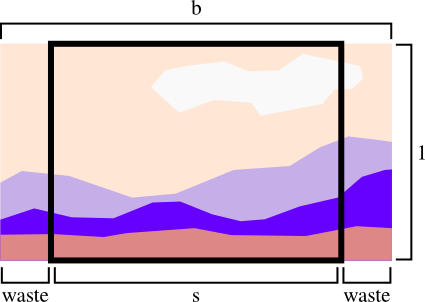
Well, denoting the aspect ratio of the screen s and the aspect ratio of the background image b, and -- without loss of generality -- assuming the screen height is 1, it is easy to draw a picture of the situation:

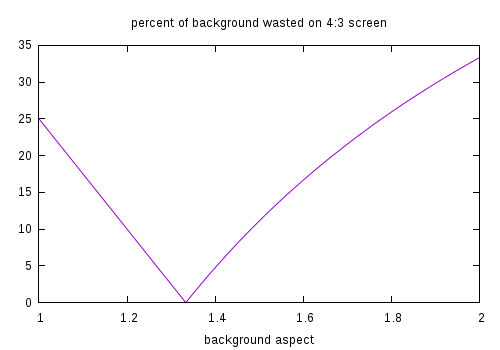
So, if the background is wider than the screen, the percentage of the background image wasted is (b-s) / b. Similarly, when the background is narrower, the waste is (1/b-s) / (1/b).

As expected, on a 4:3 screen a background image of aspect ratio 4:3 wastes the least.

Of course, on iOS one needs to worry about three aspect ratios: 4:3 [iPad], 3:2 [iPhone <= 4], and 71:40 [iPhone >= 5]. (In case you are wondering, 71:40 is 'nearly 16:9'.):

NOTE: I'm only considering landscape aspect ratios because that's the target for this game.

Assuming one wants to give equal weight to background waste on each device, the proper aspect ratio of the background image should minimize the sum of these three curves.

This minimization happens at the 3:2 aspect ratio. Indeed, my intuition is that with equally-weighted devices the minimum-waste aspect ratio will always be the median aspect ratio.

Maximizing Excitement

In the previous section, I counted areas of the background for each time they were cropped -- that is, background that didn't show at 4:3 and at 3:2 was counted as being twice as bad as background that was only cropped at 3:2. Perhaps, instead of obsessing over these lost pixels, one should instead maximize the percentage of the background that is cropped by no device (i.e. the part of the background every screen sees).

What is this percentage? Consider a background of size bx1 to be shown on screens of aspect s1, ..., sN. The width of the visible-on-all-screens region is w = min(b, s1, ..., sN), because the background will be cropped after its aspect exceeds the smallest screen aspect. The height of the visible region is h = min(1, b / s1, ..., b / sN), because of cropping on the top and bottom of edge of the background when it is scaled to the widest aspect ratio. (More intuition: consider scaling the visible region to [horizontally] fit a screen of size sx1. The scale factor is s / b, so it must be the case that h * s / b <= 1; thus h <= b / s.)

Putting these figures together gives percentage 100 * min(b, s1, ..., sN) * min(1, b / s1, ..., b / sN) / (b * 1). Interestingly, this means that maximizing visible area only depends on the narrowest and widest aspect ratio under consideration:

The unfortunate news is that with aspect ratios of 4:3 and 71:40 in the mix there isn't any background size that doesn't end up with about 25% of its area not visible on all screens. The fortunate news is that the best aspect ratio in terms of waste (3:2) is within this 75%-used plateau.

Going Further

In this article I didn't talk at all about foreground content (which must be scaled to fit within each aspect ratio), and only explored two objective functions. Other interesting objective functions might include one weighted for all browser sizes, or one that is concerned with fairness (forcing all screens to lose about the same area of the background).

If you have other ideas, feel free to leave a comment or send an e-mail.

Wednesday, November 6, 2013

Rainbow Update: More Music

I am pleased to report that the iOS version of Rainbow is proceeding well. In fact, a 1.0 version has already been accepted for app store sale (though -- owning to some gameplay changes -- I will probably not release it).

So, what have I been working on? Well, other than finding a real job, tweaking and adjusting Rainbow to be an even better game. Part of that is doing things like adding incidental music to cutscenes -- and that's what this post is about.

The Music

The most recent two tracks I added to Rainbow were an opening and closing theme for the villain (and player's persona), who I will simply call "D.D." herein.

The opening theme is meant to be sinister but energetic, as befits a villain whose goal is to bring color and happiness into the lives of a drab people:

The closing theme is meant to be similar to the opening theme but more mellow, because D.D. is now tired from the effort of playing through the game:

One of the things that I think works really well in both of these tracks is the drums. The main drums are from Reason's factory sound library, but are bit-crushed via a Scream4's "digital" method:

I also automate the 'Rate' parameter of the Scream4 in one of the tracks to get some interesting variation into the drums. It's certainly a rough sound, but it's one that I quite enjoyed using in an earlier track.

The parallel channel through the reverb and compressor is generally mixed very low, but it does provide some interesting texture. (The LFO is being used to sweep the resolution on the Scream4 in this channel, which adds more rhythm to the texture.)

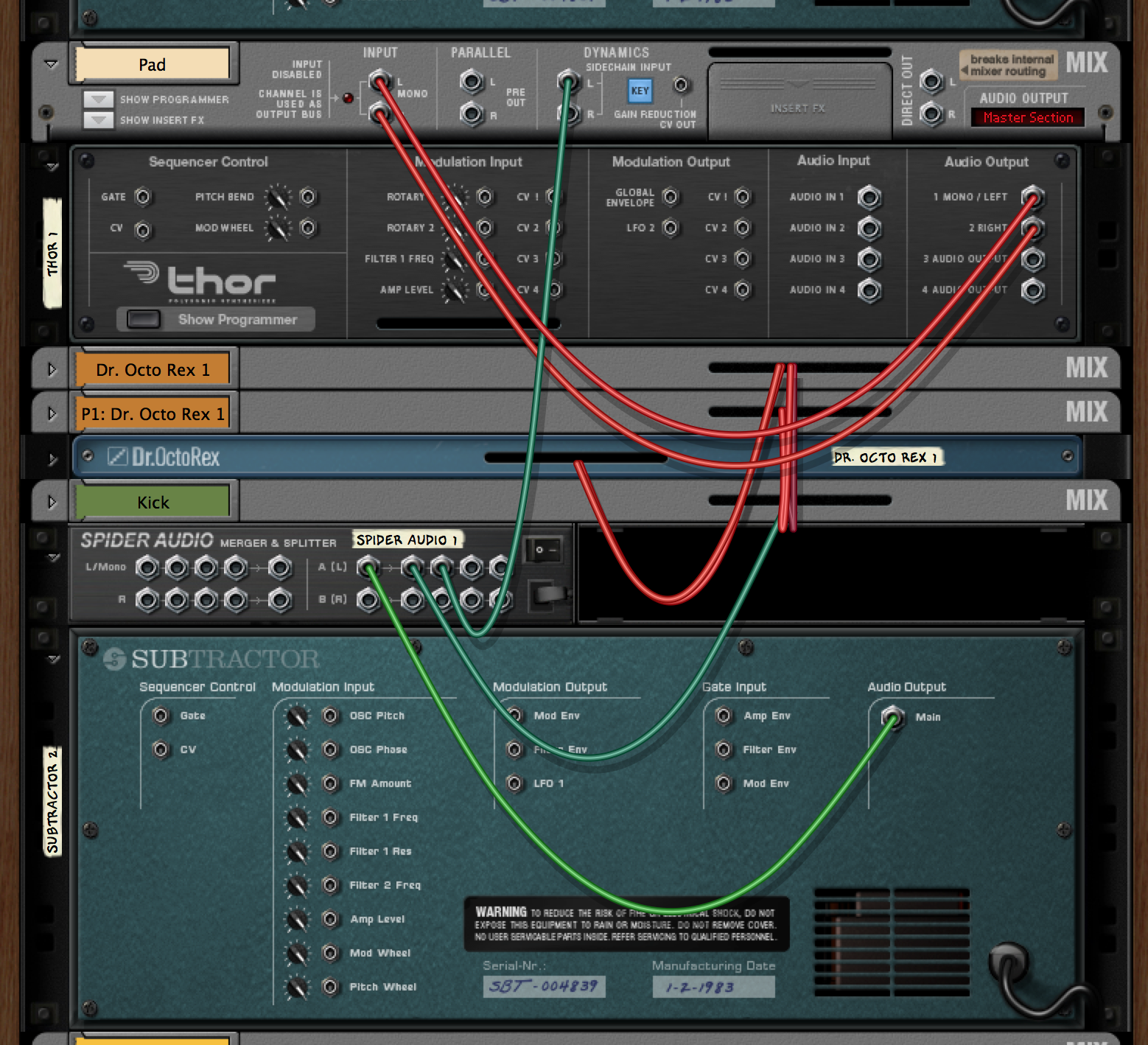
In addition to the main drums, I use a lone synth kick, without any fancy effects, in parts of the track. This kick is used as an sidechain input on the lower pad, in order to make the pad duck the kick (and thus make the kick seem to hit harder):

I doubt Rainbow will be winning any awards for cutscene music design, but these snippets certainly seem better than letting the menu theme continue to play.

Thursday, October 10, 2013

Rktcr Limited Edition (Video)

With just about 12 hours left in the Indie Game Stand sale for Rktcr, I decided to make the following video to give folks a better look at the Rktcr Limited Physical Edition, one of which has now been claimed by the highest contributor in the aforementioned sale.

So if you think this looks cool, start figuring out how to convince me to part with the other copy.

Friday, October 4, 2013

Rktcr's Limited Edition

From October 7th-10th, Rktcr was on pay-what-you-want sale at Indie Game Stand, with 10% of proceeds supporting the EFF. Paying more than average would have netted you an exclusive level pack and a custom digital wallpaper. But that's not what this post is about.

Paying the most would have gotten you one of the only two limited edition physical copies of the game. And these things are amazing. And that is what this post is about.

Each one is an obsessively-crafted testament to my deep love for Rktcr, and feature (from outside to inside):

A paper "Rktcr"-logo band, made from five interleaved sheets, hand-cut and painstakingly assembled.

A Rktcr sprite print box. Each of the four patterns used on these two boxes and their lids are unique and will never appear elsewhere.

A hand-made velvet/foam cushion to showcase...

...a USB drive filled with Rktcr v3.1 and covered in 23K gold leaf, ...

...with a silver-plated chain tassel.

These two limited edition copies are truly amazing things. They, in as non-creepy a sense as possible, reify my deep love for Rktcr, my desire to see it perfected, and my joy at finishing the game. The whole assemblage has a nice weight in the hand, and the drive and chain feel luxurious as you manipulate them.

Tuesday, October 1, 2013

Making Rktcr Levels: Bursts

I'm trying to spend most of my time as of late getting an iOS beta for Rainbow out, so this Rktcr tutorial will be a brief one.

In this tutorial, I will show you how to make bursts -- those little exploding circles that can give the player's vehicle a shove in the right (or wrong) direction.

I will be assuming familiarity with the basics, but nothing more. (Well, other than a full version of Rktcr.)

Bursts

Bursts are actually just gems with the special name. So, to make one, first create a gem (space, gem, enter), then edit its properties (tab), and set the name to burst.

You can still use the front_collide and back_collide properties, like on gems, to change which wheel(s) will trigger the burst.

And that's it! A short tutorial, to be sure, but the upcoming one about style layers will be quite a bit longer. (And, after that, there's only claims and I'll have taught you all there is to know about Rktcr level editing.)